My Ageless Best

The future isn't just ahead of us. At any age, it's ours to create.

Sunrise over autumn hills, with a picnic table holding a journal, a mug, and a laptop.
  • What an anxious week taught me about separating the real concerns from the noise

    I haven’t slept well this week. And I know I’m not alone. We all lived it. Flights were stopped across the whole country, the banks were having trouble, Apple and Microsoft went down, even the NSA’s own network went dark, and in the middle of it the FBI put out a warning about a powerful new hacking tool. I found myself doing what I suspect a lot of people were doing: adding it up and wondering whether it was connected, whether somebody had planned it. I wondered that more than once — and even my Garmin alerted me that I was not calm about it.

    A cybersecurity expert has said that people he has not spoken to in 15 to 20 years are calling him in a panic, certain the power grid is about to go down. I recognize myself in that. I too have wrestled with a question that has no clean answer: how much of my time and energy belongs to preparing for something that might never happen, and how much belongs to simply living my life? This week it felt as if the worst had arrived to collect. Each scary scenario had a different set of preparations involved, and I did not know which way to turn.

    When I remembered the motto that I have lived by since I was a little girl in a Brownie uniform: Be Prepared. It has been the Girl Scout motto for more than a century, and it has been mine for most of my life. Sitting with it, I realized that the motto has never once said be frightened. A healthy sense of preparation is a good place to land — prepare in measure, keep it in its proper size, and then go live your life. So I took inventory, and I did my best to be prepared.

    From that steadier place, I did what preparation actually asks of a person. I slowed down, and I checked each frightening outage one at a time, on its own evidence. I did not assume that they were unconnected. I looked for the connections honestly, for any consistency or thread running between them. Each time I dug into one, I found a separate, ordinary reason: a software bug in a bank’s own hardware, an update a company pushed to its own systems, a security patch that broke the network that it was meant to protect. No thread held. They were not one story, and nobody had to plan them.

    The air traffic failure was different, though. It had a story underneath it, reported in pieces, months apart, and only now beginning to be put together. Now, I’m not an engineer, and I will not pretend to explain the equipment. But the story underneath this one is not about equipment. It’s about management and good judgment. Last December, the government handed oversight of the air traffic control rebuild to a company called Peraton. Peraton does not do the hands-on work; it is paid to manage the companies that do. Before the award, the FAA’s own reviewers rated Peraton’s financial condition “high risk.” The competitor was rated “low risk.” The normal purchasing rules were waived. Peraton got the job anyway. The mandate was called “No Excuses,” and it demanded and rewarded unprecedented speed.

    One finding in the government’s own audit caught my attention. There was no single master schedule tying thousands of projects together — more than 11,000 individual schedules, not yet integrated into one. I don’t need to understand telecommunications equipment to recognize why that is alarming. If nobody can see the whole undertaking in one place, it’s not being managed. The auditors also warned that putting speed first could lead to disruption. Whether that contributed to Friday’s failure has yet to be established. Then, after the failure, the administration raised its request to $50 billion — for air traffic control and airports — and it wants the vote rushed through the Congress that is about to leave. You have to look at it closely to realize that the increase does not include the control system that failed. When the rules are waived at the start and the warnings are overruled at the start and the response to failure is a request for more money, that is a concern with specific, documented reasons behind it. That concern is real.

    Here’s what I’ve landed on, and it’s bigger than one program or one frightening string of days. Fear grows fastest in a pile-up, when everything frightening arrives at once and the internet is happy to help us stay frightened — the floating theories, each one feeding the next. The way out is not to stop caring, and it is also not to spend life on worry. We must look at each issue rationally, one at a time, and test whether the connections are real. We must be concerned about the things that hold up under checking, and give them our full attention in our just-in-case preparations. We can’t let the other things be a distraction.

    Sources

  • by Sherri Weidman

    How a conversation with three AI assistants turned into something surprisingly familiar.

    I had to laugh at myself the other day. I was trying to figure out what to do about a project that wasn’t going quite the way I’d hoped, and I wanted some fresh thinking before deciding whether to change direction.

    So I did what I’ve increasingly found myself doing these days. I turned to my three AI assistants—Chatty, which is what I’ve called ChatGPT almost from the beginning, Muse, and Claude. I started talking through the situation with each of them.

    One would make a suggestion that I thought was worth exploring, so I would take the idea to both of the others and ask what they thought. Their responses might raise a new question, improve on the original idea, or take it in a different direction.

    Pretty soon I was moving the conversation among all three of them. I was the one carrying everyone’s ideas back and forth while deciding which ideas were worth pursuing, questioning the ones that didn’t make sense to me, and ultimately deciding what would become part of the plan.

    Their roles had even begun to define themselves, and not because I had assigned them. They weren’t all contributing the same thing, which was part of what made the process work. The strongest teams I’ve known aren’t made up of people who are all good at the same things or who think the same way.

    Chatty is the one I typically use when I want to think something through. We research, analyze, question assumptions, shelve ideas, go back to things we discussed months ago, and sometimes change direction entirely. And apparently every staff still has that one person who has one more thought before the meeting can end—that’s Chatty.

    Muse has a different role. Muse keeps an eye on the bigger picture—what I said I wanted to accomplish in the first place, whether what I’m doing now still supports that, and whether I’m beginning to wander off in some interesting but completely different direction.

    Claude handles operations. Once we’ve decided what should happen and I’ve given him clear instructions, he can actually work on my computer, using the programs I’ve given him access to, and carry out the assignment. I can give him his assignment, go to bed, and while I’m sleeping, he works the night shift. I still find that amazing.

    What surprised me was how quickly they began building on one another’s thinking rather than defending their own. And somewhere in the middle of all of this, I had the strangest sense of déjà vu.

    Maybe that shouldn’t have surprised me. I’ve spent most of my life in meetings—staff meetings, board meetings, committee meetings, you name it.

    By the end, we had looked at the problem from several directions, challenged the original plan and made it better. We ended up with a better plan than the one I started with, and everybody had an assignment, including me.

    I’ve run enough staff meetings to know one when I’m in one.

  • When I lived in Florida, there was almost always something happening on my nature walks.

    There was an alligator who lived near one of my regular routes, and I would go out wondering if he would be there. Sometimes he was. I had a favorite anhinga, too, who was almost always around, sometimes spreading and flapping his wings and making his strange calls. Wading birds searched the shallow water for food, and what seemed like countless bunnies darted back and forth across the trail. Around sunset especially, the whole place seemed to come alive.

    I wasn’t just going out for exercise. I wanted to immerse myself in the landscape and, for a little while, in their world.

    I lived in Florida for fifteen years, so this wasn’t the novelty of being on vacation. It was home. But somehow there were still things that made me stop and watch.

    Kentucky is home now, but the landscape was familiar long before I moved here. I’ve lived the bulk of my life in the Midwest and spent years in woods much like these. Trees and trails, fallen leaves and the four seasons are familiar.

    Now that I’m living and walking in Kentucky, I’m wondering if I can learn to see this familiar landscape differently.

    So I’ve been wondering what someone who had lived in Florida all their life would see here. What would catch their attention? What might seem remarkable to them simply because it isn’t familiar?

    And maybe the bigger question for me is: What happens when the extraordinary becomes ordinary simply because we’ve seen it so many times?

    There’s a line from Marcel Proust that I’ve been thinking about. He wrote that the true voyage of discovery would be “not to visit strange lands but to possess other eyes.”

    I don’t know whether we can actually train ourselves to do that, but I’d like to try.

    For the next few walks, I’m going to pay attention to more than what catches my eye. I’m interested in what draws me in—what makes me curious, inspires me to come back or learn more, or simply delights me in the moment.

    And now I’m wondering about other people, too. Not the most spectacular place you’ve traveled or the most amazing thing you’ve ever seen. I’m curious about the ordinary places where you live. Where do you find awe?

  • I frequently use AI for help with financial matters. Today that meant car maintenance.

    My car is due for an oil change, a new air filter, and a new cabin filter. So I called the repair shop that most recently did maintenance on my car. I trusted them. They were less expensive than the dealership, and I felt like they did honest work.

    Their quote came back at $245.76.

    Something about that seemed kind of high to me. I had even asked about that price on the phone, with the shop explaining that cabin filters are hard to install. They’re in unusual positions, he said, and they take longer.

    Not convinced, I gave ChatGPT the quote and asked what it thought.

    It immediately pointed to the cabin filter charge as being out of line. I told it what the guy at the shop had said about the filter being hard to replace because of where it was located.

    ChatGPT said, not in a Mazda CX-5.

    That was new information I would never have known otherwise.

    I asked ChatGPT to find some highly rated auto maintenance businesses near me. It found three and recommended one above the others. I called that one.

    Their price for the same work was about $135.

    That’s roughly $111 less.

    I pay about $20 a month for ChatGPT.

    Today it shaved $111 off the price I was quoted for my next car bill.

  • Why I Said No Thanks

    When I first heard about Muse, Meta’s new AI agent, my reaction was pretty much, no thanks.

    Facebook already seems to know a little too much about me. You know how you look at something online and suddenly there’s an ad for it in your Facebook feed? I wasn’t particularly interested in giving Meta even more information it could use to lead me down more rabbit holes.

    But I figured I should at least find out what Muse was all about and how it was different from the AI I was already using. So I watched a few videos. One showed a mother whose Muse-created newsletter arrived each morning for her family to read at the breakfast table. I also listened to Mark Zuckerberg talk about using Muse with his children.

    I thought that would have been fabulous at another stage of my life, but it wasn’t exactly my life now.

    I’ve been working for some time on four areas of my life that I want to move forward. Sometimes when you’re trying to create a new habit, the steps forward aren’t all that clear. One of mine wasn’t developing the way I hoped.

    What Changed My Mind

    That’s when the light bulb went off.

    What if I gave that one to Muse?

    I gave Muse the goal and asked it to help me figure out how to work on it.

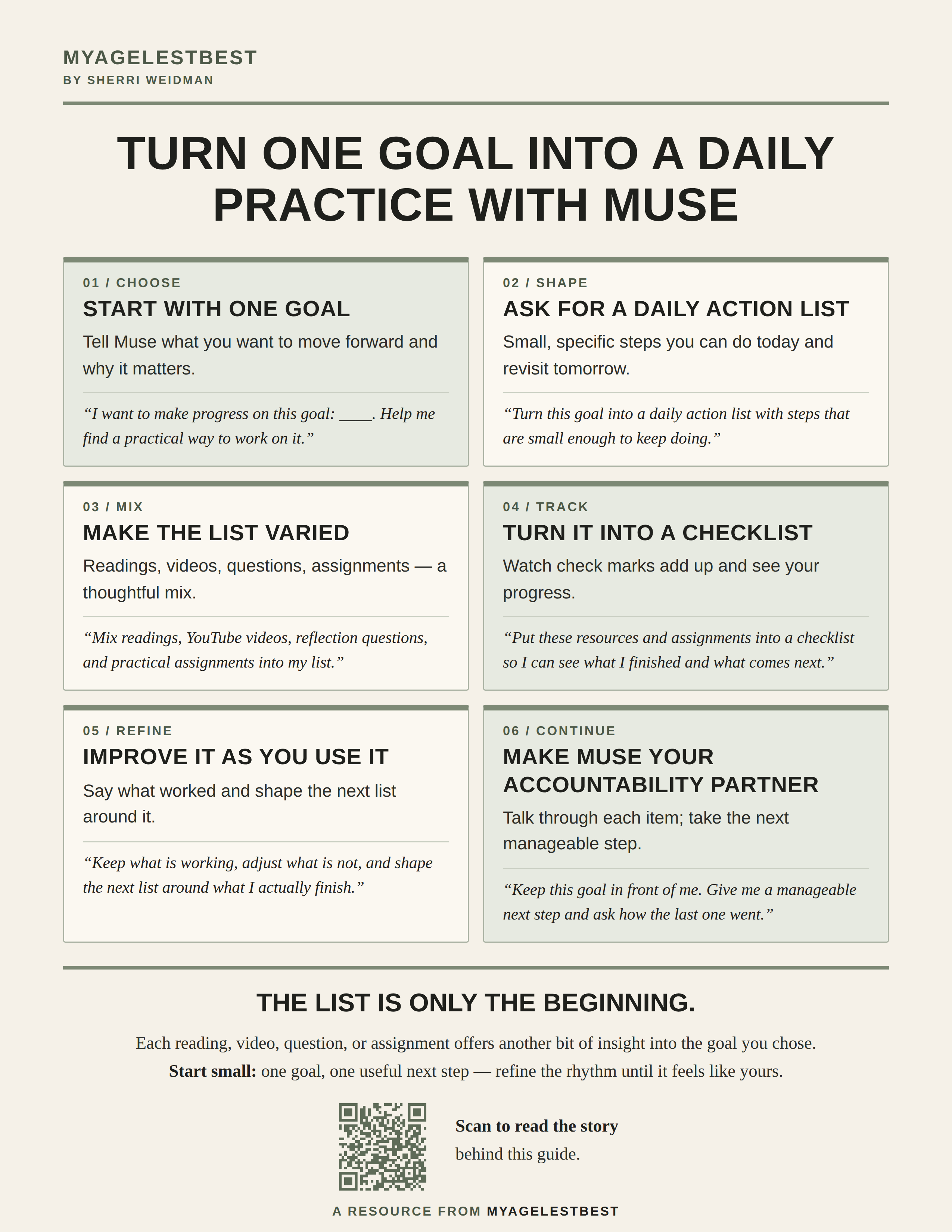
    What evolved was my own version of that morning newsletter—a daily action list. Muse gives me things to read, YouTube videos to watch, questions to think about and assignments to do.

    As I used it, I kept thinking of ways to make it work better for me. At first Muse was simply giving me resources, and I found myself going back and forth trying to remember what I had already read or watched.

    My Daily Practice with Muse

    So I asked Muse to turn them into a checklist.

    Now I can check things off as I complete them and see my progress. It sort of gamified the whole thing. It feels less like work when I watch those check marks add up. Muse has also become a little like an accountability partner.

    But the daily list isn’t just a list of things to get done. Each reading, video, question or assignment gives me a little more insight into the goal I’m trying to develop.

    And because Muse keeps putting it in front of me every day, it’s pulling something I’ve chosen to work on into my orbit.

    I almost passed on Muse simply because it came from Meta. But I took a second look, and found it very useful.

    Want to try this yourself? Here’s a simple way to start with Muse.

  • There’s a stage of life where nothing is wrong, exactly—but something feels slightly out of alignment. The way we eat, the way our homes function, the way our days flow no longer match who we are now. This is a story from a moment like that, when I slowed down long enough to think out loud, reconsider what I already had, and gently reshape my space to support the life I’m actually living.

    I wasn’t 100% gung ho about reorganizing the kitchen, and the thought of it kept me awake.

    In the early hours of the morning, I talked though my kitchen with a digital assistant that helped me notice patterns – every cabinet and drawer, talking out what to keep, what to move, and how to shape my kitchen for the way I actually live now. I described where things were, what I used, what I didn’t, and what felt like friction every time I opened a door.

    By the time we finished mapping it, I felt steadier—and finally ready to rest.

    The Brunch Bowl That Fueled the Day

    When I eventually made my way to the kitchen later that morning, it wasn’t really breakfast anymore. It was more like a calm, intentional brunch. I needed something that would carry me through the physical work ahead. My daughter was coming later to help me reorganize, and I wanted to feel grounded before the lifting, sorting, and decision-making began.

    I told my AI what kind of day it was shaping up to be and what kind of energy it would require. It translated that into a recipe that was light, sustaining, and quietly satisfying. Nothing fancy. Just the right balance of fuel and comfort.

    As I stirred the berries through the yogurt, I realized this is what it looks like when I use technology as a thinking partner.

    It doesn’t tell me what to do. It listens. It interprets. It keeps track of my nutrition quietly in the background and helps me see the next right step—whether I’m planning meals, reorganizing my home, or building my small business.

    By the time my daughter arrived, I wasn’t anxious anymore.

    Mapping the Kitchen

    I had a plan—not a rigid checklist, but a calm internal map of what mattered, what didn’t, and what could wait. The kitchen no longer felt like a puzzle with too many options. It felt like a space ready to be shaped.

    We started where the friction lived.

    Cabinets that once supported a life of entertaining—rows of wine glasses, cocktail tools, and party supplies—were gently reassigned. Not discarded in a rush, but re-zoned with respect. What I actually used every day moved into easy reach. What belonged to an earlier chapter found a quieter home or went into a donation box. A few beautiful pieces stayed, not because I might need them, but because I liked them.

    Reassigning Space with Intention

    One under-counter cabinet, in particular, changed purpose. It had been dedicated to wine and entertaining supplies—things that once made sense for a more social, hosting-oriented season of my life. But that setup no longer reflected how I live or use my kitchen now. Reclaiming that space for practical things—quietly shifted the feel of the entire kitchen. The room began to support my current needs instead of preserving an old setup.

    When Space Reflects the Life You’re Living

    That small change made me think about how easily we hold on to space for lives we’re no longer living. Not because we’re attached to the objects themselves, but because we’re keeping room for a version of ourselves we might return to someday—just in case. It’s the same impulse that keeps multiple sizes of clothes hanging in a closet, waiting for a future body or a past one. Over time, those “just in case” choices add up. They ask more from our homes, more from our energy, and sometimes more space than we truly need.

    Even the countertops shifted—from surfaces that quietly accumulated clutter to defined stations that supported my rhythms. Coffee and tea where mornings begin. Appliances I actually use kept visible without apology. Prep space left intentionally open, not empty, but ready.

    What Changed — and Why It Matters

    Nothing dramatic happened.
    No before-and-after shock photos.
    No minimalist purge.

    And yet—by the end of the process, the kitchen felt different.

    Lighter.
    Quieter.
    More cooperative.

    What surprised me most was how physical the relief was. My shoulders dropped. Decisions stopped stacking up in my head. I wasn’t managing my kitchen anymore—it was supporting me.

    Organization isn’t about perfection. It’s about reducing resistance.

    When your environment matches your real life—your appetite, your energy, your age, your values—everything takes less effort. Eating better feels easier. Cooking feels less taxing. Even rest comes more naturally.

    A Different Kind of Intelligence


    This is what working with AI looks like in my real life.

    It isn’t about automation for its own sake.
    It’s about having a steady partner who can hold the details while I listen to my body, my space, and my intuition.

    Together, we didn’t just plan a kitchen.
    We reclaimed a rhythm.

    And that bowl of yogurt and berries?
    It didn’t just fuel the work.

    It marked the moment I stopped trying to live like a former self—and started living for my best self again.


    THE BRUNCH BOWL THAT FUELED THE DAY
    Simple, sustaining, and intentionally balanced

    Cottage cheese (2%): 100 g
    Fage 2% plain Greek yogurt: 80 g
    Trader Joe’s Berry Cherry Blend (frozen): 56 g (weigh frozen; thaw slightly)
    Chia seeds: 1 teaspoon
    Crushed walnuts: 1 tablespoon (about 7 g)
    Cinnamon and vanilla extract: to taste

    Better yet: Build it in a clear glass or stemless wine glass to showcase the layers—a small luxury in the middle of a busy, physical day.

  • Louisville, Kentucky

    When I packed up my life in Naples, Florida and moved to Louisville, Kentucky at the end of 2024, I imagined a graceful transition. New city, new routines, new chapter. I am, after all, a systems person — someone who appreciates order, efficiency, and workflows that make sense.

    What I did not imagine was stepping into the Twilight Zone of public services, where every system seemed to be buckling under its own weight, and where the most reliable element of my daily life would turn out to be the barometric pressure.

    But let’s start at the beginning.


    ACT ONE: The USPS Twilight Zone

    My small business depends on USPS, and the postal system in Naples ran like a dream. If a substitute carrier missed a pickup, I could stroll in the back door of my local post office, hand my package to a smiling clerk, and be wished a lovely day.

    So imagine my surprise when, here in Louisville, my eBay packages began disappearing into the ether. Pickups were regularly missed and even marked as “completed” when they had never been touched. The local post office seemed allergic to accountability. Supervisors were never “in.” Staff never knew who to call. People shrugged a lot.

    It didn’t take long to realize this was a systemwide issue. The problems were in the media, whistleblowers were speaking up, and even our Congressman weighed in — all without a meaningful official response.

    And then, slowly, the chaos eased.

    Whether it was internal reorganization, staffing changes, or just the natural cycle of a strained system, things began improving. I got a new mail carrier named Trey — cheerful, punctual, meticulous. He leaves me little notes like, “Got it, Ms. Sherri,” when he collects my packages.

    One day, after picking up a tiny ceramic mailman figurine at Goodwill, I caught him at the door and handed it to him. His whole face lit up. He tucked it into his pouch as if it were a treasure.

    And just like that, Louisville redeemed itself a little.


    ACT TWO: The DMV That Time Forgot

    First, let’s review Kentucky’s motor vehicle rules:

    • You have 30 days to get a new driver’s license.
    • You have 15 days to register your car.
    • You cannot register your car until after you get your Kentucky license. Huh?

    This alone could be a comedy sketch. But it gets better.

    When I attempted to follow these rules, Louisville’s DMV system had collapsed so thoroughly that:

    • Lines stretched around buildings in the freezing cold
    • People were kept outside
    • A worker barked orders like a drill sergeant
    • Appointments vanished the moment they opened
    • And yes — there was even an incident involving gunfire in the lines at one point.

    By then, it was clear: Louisville’s DMV wasn’t just overwhelmed — it was in crisis.

    At one point I drove to the main branch to check things out in person. A staffer marched up and down the curb shouting instructions, telling people they couldn’t come inside yet, exactly where to stand, and generally giving off the energy of someone guarding the last lifeboat on the Titanic.

    I lasted about ten minutes in that non-moving line before giving up and returning home.

    Louisville simply wasn’t going to allow me to become a legal resident anytime soon. The system was too overloaded.

    The escape route?
    Drive an hour to Frankfort — which had available appointments.

    So I did. And finally — months after moving, in the spring — I got my Kentucky driver’s license.

    Then I had to begin the separate process of getting my Kentucky plates, because unlike Florida, where everything happens efficiently under one roof, Kentucky prefers to make it a scavenger hunt.

    At this point, I had been driving around with Florida plates long past the “legal” window, hoping no policeman pulled me over and forced me to explain that I had been trying — genuinely — but Kentucky wouldn’t let me follow Kentucky’s own rules.


    ACT THREE: My Arm Joins the Circus

    Meanwhile, my body staged its own rebellion.

    My right arm began hurting — badly. Daily aching, stiffness, weakness. I worried something serious was happening.

    Trying to get into a doctor? Long waits.

    Everything was booked, not taking new patients, or delayed by months.

    It wasn’t until much later that I discovered the culprit to my arm pain was barometric pressure drops and bone-dry winter air.

    My new weather station helps keep me on track.
    My new weather station helps keep me on track.

    It wasn’t just the weather that needed to settle — I did too. My body had moved to Kentucky long before my habits did, and I had to learn how to live here. Florida had never asked anything of me seasonally; Kentucky demanded adjustments..

    Even my own internal “system” needed a reboot.


    THE SYSTEMS PERSON IN THE SYSTEM DESERT

    This was perhaps the greatest internal struggle:

    I had moved from Naples — the land of smooth workflows and functioning systems — into a place where every process seemed to be designed by someone drawing steps out of a hat.

    Meanwhile I’m the kind of person who loves a good checklist.

    So there I was:

    • USPS in meltdown
    • DMV in chaos
    • Medical access in gridlock
    • Weather sabotaging my arm
    • No plates
    • No license
    • No clarity

    And I kept thinking: Is this real life?


    RESOLUTION: KENTUCKY REDEEMS ITSELF

    Slowly — and quietly — things stabilized.

    My arm pain went away with the humidity of spring and summer.
    Doctors were found.
    The DMV sorted itself out.
    My packages began to move again.
    Trey became a bright spot in my daily routine.
    My apartment began to feel like home.
    My walking routes grew familiar.

    And most importantly:

    I am just a few minutes from my daughter, my son-in-law, and my granddaughters — the real anchors that made every challenge worth it.

    Kentucky didn’t welcome me with open arms at first.

    But it gave me something better: proximity to the people who matter most. Family dinners, graduations, quick visits, unplanned moments — things I couldn’t have in Naples.

    Kentucky is eccentric, imperfect, and rough around the edges… but it’s also the place where I get to see my granddaughters, where my daughter and son-in-law are just a short drive away, and where the people — from family to a mailman named Trey — became the quiet gift in the middle of the chaos.

    I made it. And now, Kentucky is where I’m building my next chapter.

    Because sometimes the moves that feel the most chaotic end up giving you the best stories — and bring you closer to the people you love.


    Get new posts by email. I share reflections, experiments, and lessons as I build My Ageless Best — quietly and thoughtfully.

  • Welcome — I’m so glad you’re here.

    My Ageless Best is a space where I’m sharing the things that shape this season of my life: learning, evolving, becoming… and discovering what it means to live with more ease, purpose, and curiosity every day.

    You’ll find reflections, stories, and practical insights from my own journey — from health and habits to thrifting adventures, creativity, and everything we learn along the way. My hope is that something here encourages you, comforts you, or helps you feel a little more at home in your own life.

    Thanks for stopping by. I’m just getting started, and I’m glad you’re here for the beginning.